Peony
The classic round burst of coloured stars with no trails: clean dots of colour.
Also called: botan
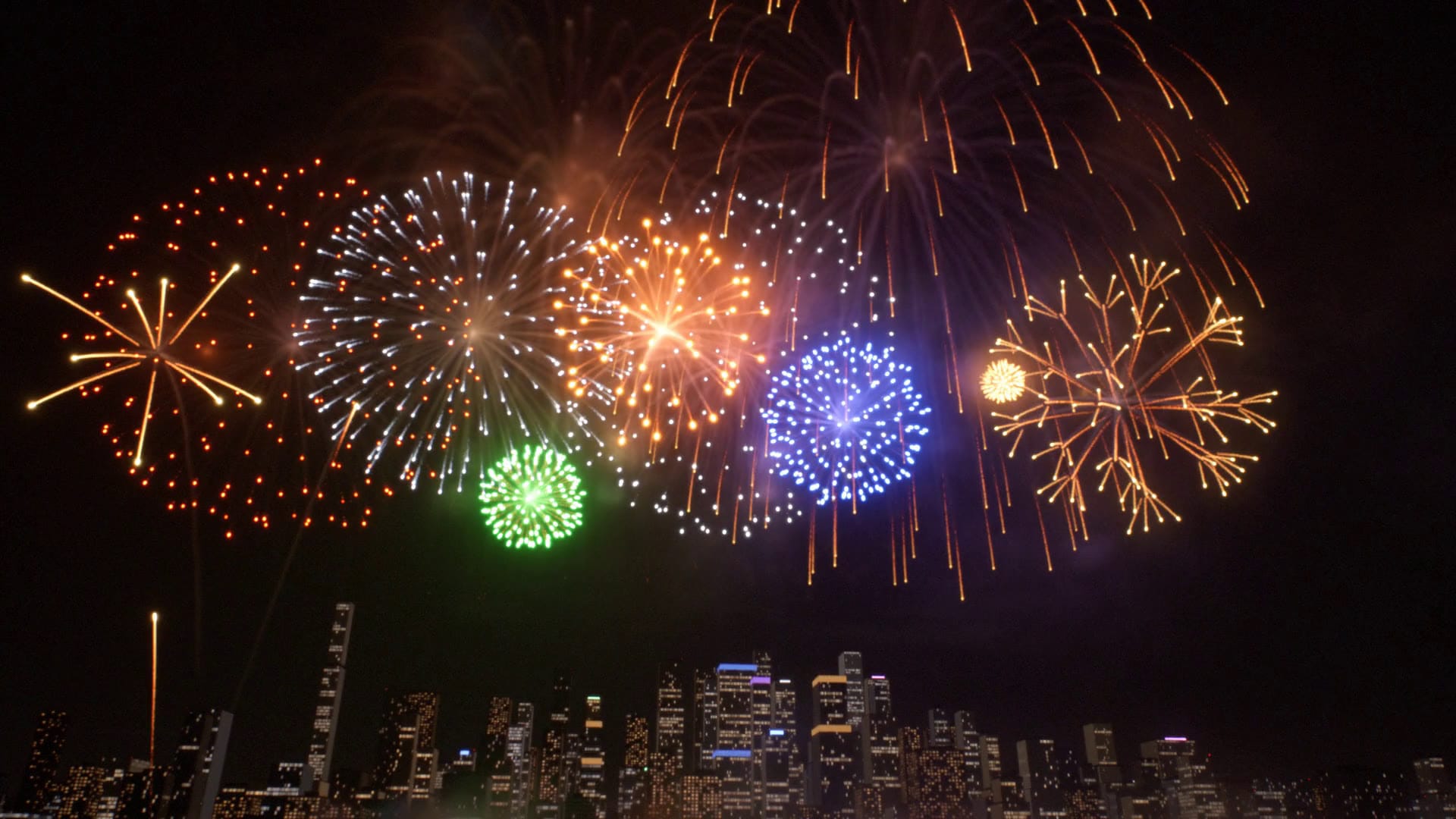
The peony is the most common aerial shell in the world: a sphere of colour stars thrown evenly outward from the break, burning as clean points of light. Unlike a chrysanthemum, its stars leave no visible spark trail, so the burst reads as a ball of coloured dots.
Peonies are the backbone of most displays because they come in every colour, change colour mid-flight (red to green, for example) and read clearly at any size, from a 2.5" shell to an 8" multicolour break.
How it works
A spherical shell carries one layer of round stars packed around a central burst charge. The time fuse fires the burst charge near the top of the flight; it breaks the casing and throws the stars out at tens of metres per second. Colour comes from metal salts in the star composition (strontium for red, barium for green, copper for blue, sodium for yellow). Each star burns for one to two seconds while air drag slows it to a gentle fall.
How to recognise it
- A round sphere of separate coloured points, no lines behind them.
- All stars go out at nearly the same moment in a well made shell.
- Colour-changing peonies switch every star at once (a "to" in the name: red to green).
How designers use it
- Use peonies for colour statements and for hitting accents in the music: they open fast and read immediately.
- Stack two or three colours on the same beat across barges for a chord of colour.
- Bigger calibers open wider and higher: a 3" peony spreads ~70 m, an 8" over 200 m.
Peony shells in PyroViz
These are the peony shells in the designer's library, with the figures the simulator derives from their physical parameters: where they break, how wide they open and how long they stay visible.
| Shell | Caliber | Breaks at | Spread | Lift | Visible | Colours |
|---|---|---|---|---|---|---|
| Yellow Peony 2.5" Spherical break of yellow stars without trails; stars race out, brake hard in the air and go out together. | 2.5" | 81 m | 66 m | 3.05 s | 2.9 s | |
| Red Peony 3" Spherical break of red stars without trails; stars race out, brake hard in the air and go out together. | 3" | 95 m | 68 m | 3.35 s | 1.6 s | |
| Green Peony 4" Spherical break of green stars without trails; stars race out, brake hard in the air and go out together. | 4" | 127 m | 118 m | 3.85 s | 2.9 s | |
| Blue Peony 5" Copper-blue peony. Blue stars are the dimmest colour (CuCl emits weakly and decomposes in hot flames), so on camera this reads as a darker, saturated blue that clips less than other colours. | 5" | 161 m | 122 m | 4.3 s | 2.3 s | |
| Purple Peony 5" Spherical break of purple stars without trails; stars race out, brake hard in the air and go out together. | 5" | 161 m | 126 m | 4.3 s | 2.5 s | |
| Red Peony 6" Spherical break of red stars without trails; stars race out, brake hard in the air and go out together. | 6" | 193 m | 150 m | 4.6 s | 2.2 s | |
| Red to Green Peony 6" Layered (henka) stars: a red outer layer burns off and every star turns green at the same moment. | 6" | 193 m | 158 m | 4.6 s | 2.7 s | |
| Silver Peony 6" Magnalium white stars: brightest colour per gram, clip to white on camera even at the edges. | 6" | 193 m | 138 m | 4.6 s | 1.9 s | |
| Multicolour Peony 8" Four colours of stars mixed evenly through one spherical break. | 8" | 254 m | 246 m | 5.2 s | 4.5 s |
Related effects
- Chrysanthemum: A round burst whose stars draw lines of sparks as they fly: petals of light.
- Dahlia: Fewer, bigger, longer-burning stars: a sparse burst of fat colour points.
- Pistil: Concentric spheres: an inner core of another colour inside the main burst.
- Ring and Saturn: Stars packed in a flat circle: a ring, or a ring around a sphere (Saturn).
Put it in your show.
Open the designer, filter the effects by "peony", audition a shell and drop it on the beat.