This is a design aid, not a permit. Real displays must follow the regulations of their jurisdiction and be planned and fired by licensed operators. Local rules can require larger distances than the figures below.
The 70 feet per inch rule
In the United States, NFPA 1123, the Code for Fireworks Display, sets the minimum separation between the mortars and the spectators for vertically fired aerial shells at 70 feet per inch of mortar diameter. In metric terms that is about 21.3 m per inch of shell size.
The distance is measured as a radius from the mortar, so it describes a circle that must be kept clear of spectators. On a barge or a site with several sizes, the largest shell fired from that position sets the radius.
Distances by shell size
| Shell size | Radius (ft) | Radius (m) | Clear area diameter (m) |
|---|---|---|---|
| 2" | 140 | 43 | 85 |
| 2.5" | 175 | 53 | 107 |
| 3" | 210 | 64 | 128 |
| 4" | 280 | 85 | 171 |
| 5" | 350 | 107 | 213 |
| 6" | 420 | 128 | 256 |
| 8" | 560 | 171 | 341 |
| 10" | 700 | 213 | 427 |
| 12" | 840 | 256 | 512 |
These distances are similar in size to how wide the shells open (a 6-inch breaks around 150 m across), which is no accident: the rule keeps the crowd clear of falling debris and of shells that malfunction.
Applying it to a layout
On a waterfront, barges let you push the mortars away from the crowd: the water inside the circle does not need to be guarded the way a park does. When you lay out a show:
- Draw the circle for the largest shell on each launch position, not the typical one.
- Keep the audience line, boats and buildings outside every circle, including the circles of the outer barges.
- Angled mortars shift where shells break and fall: never angle them toward the audience, and allow for the shift.
- Wind carries debris and burning stars downwind. Plan for the prevailing wind, and expect to move or remove large shells on a windy night.
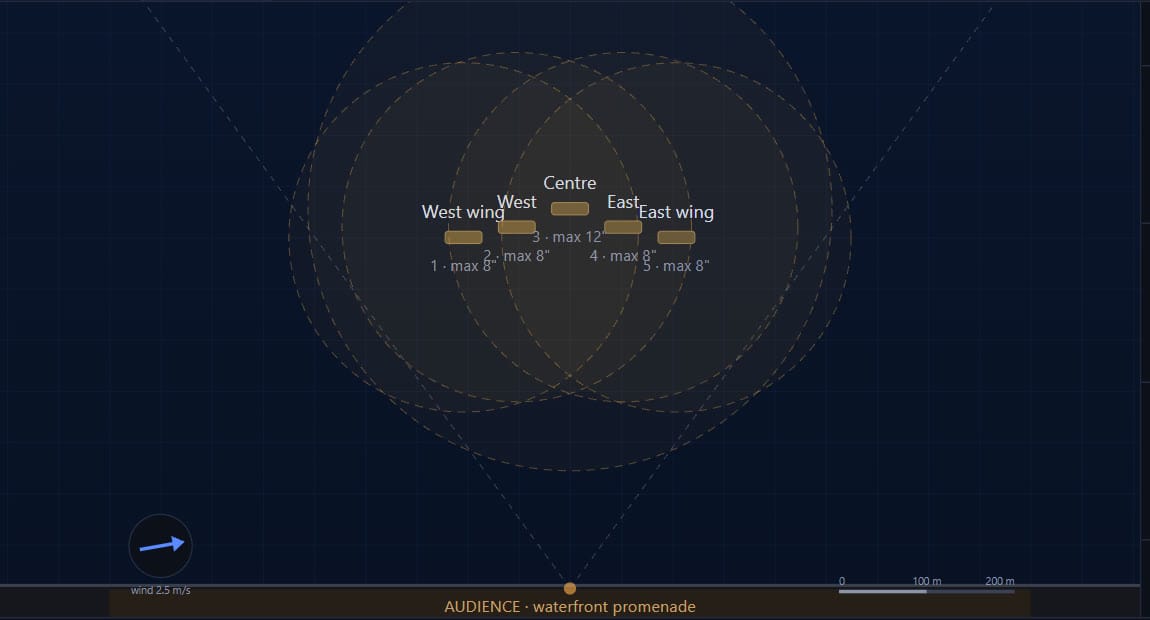
The PyroViz venue map draws the 70 feet per inch circle for each barge, from the largest shell on its lane, and turns it red if it crosses the audience line. Change a cue from a 6-inch to an 8-inch and you see the consequence immediately.
Beyond the minimum
The minimum is a floor. Operators and authorities often add margin for heavy wind, for shells known to break low, for multi-break and salute shells, and for spectator areas that are hard to control. Fallout areas, fire risk on land, boat traffic and the storage and handling of the product all add their own requirements. Use the circles to design something that will fit, then let the licensed operator and the authority decide what is allowed.